


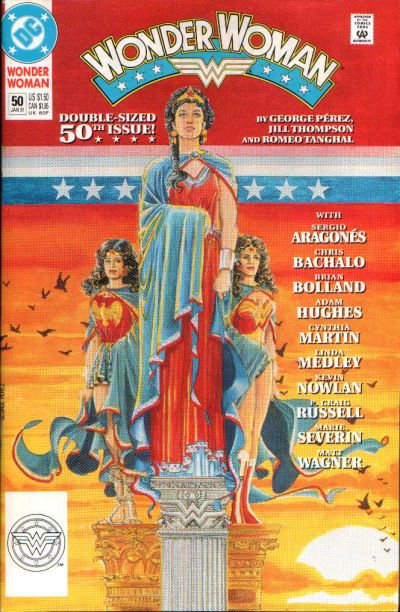
January 1991: A new Wonder Woman series, initially scripted by Greg Potter and co-plotted and drawn by George Pérez, had launched a year after the end of the old one. (In between the two ongoing series, there was a low-profile four-issue miniseries, The Legend of Wonder Woman; at that time, apparently, DC was contractually obligated to publish at least four comics a year with Wonder Woman as their lead feature, or the rights to the character would revert to William Moulton Marston’s estate.) The new series’ first fancy anniversary issue is #50, by which point Pérez is writing it by himself and Jill Thompson is the regular penciller. It’s pretty impressive how many of the guest artists who contributed one-page pin-ups to this issue–including Chris Bachalo, Adam Hughes and P. Craig Russell–are still big names in comics. On the radio: Pebbles’ “Giving You the Benefit.”
(More on Techland: DC Comics Partners With comiXology and PlayStation, Will Offer Day and Date Books)
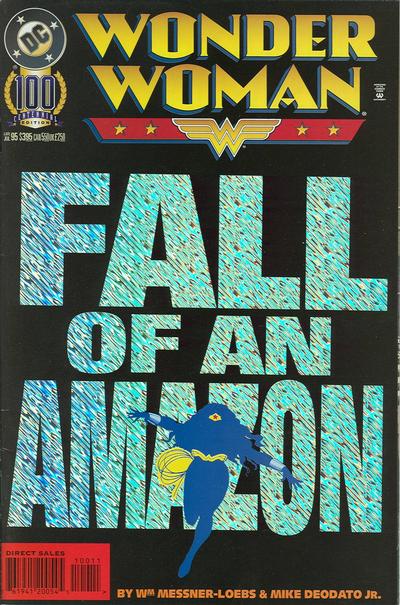
August 1995: William Messner-Loebs and Mike Deodato wrap up their “Artemis takes over for Diana as Wonder Woman” storyline in Wonder Woman #100, the month before John Byrne takes over writing and drawing the series for the next three years. Foil-enhanced covers were very popular in those days. On the radio: Method Man and Mary J. Blige’s “I’ll Be There For You/You’re All I Need to Get By.”
(More on Techland: Superman: All the Anniversaries)
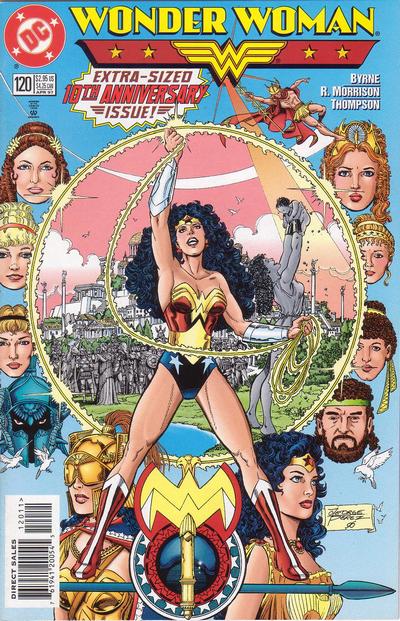
April 1997: Perhaps eager to make up for the low anniversary-issue quotient of the character’s early years, Wonder Woman #120 is an “extra-sized 10th anniversary issue”–although the second series actually began in February, 1987. (It missed a few months of publication after Pérez left.) This one’s got a lead story by Byrne and a backup by Ruth Morrison and returning artist Jill Thompson. On the radio: Toni Braxton’s “Un-Break My Heart.”
(More on Techland: Origins: Chris Roberson)
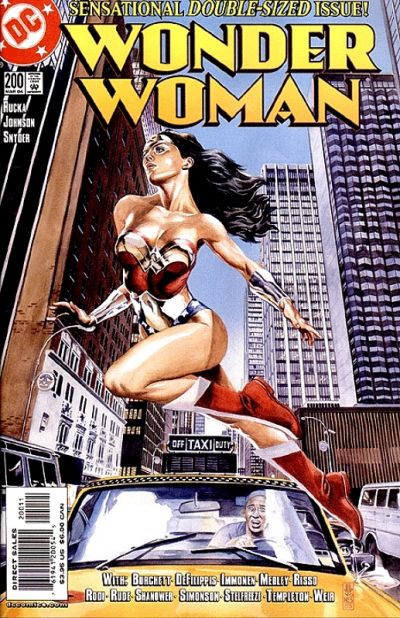
March 2004: The lead feature of Wonder Woman #200, the conclusion of Greg Rucka and Drew Johnson’s “Down to Earth” storyline, is augmented by a bunch of pin-ups and short stories–Robert Rodi and Rick Burchett contribute a tribute to Golden Age Wonder Woman stories, and Nunzio DiFillipis, Christina Weir and Ty Templeton’s “Amazon Women on the Moon” is a Silver Age homage. Rucka continues writing the series until it ends with April, 2006’s #226, in the middle of Infinite Crisis. On the radio: Alicia Keys’ “You Don’t Know My Name.”
(More on Techland: A Brief History of Jonah Hex)
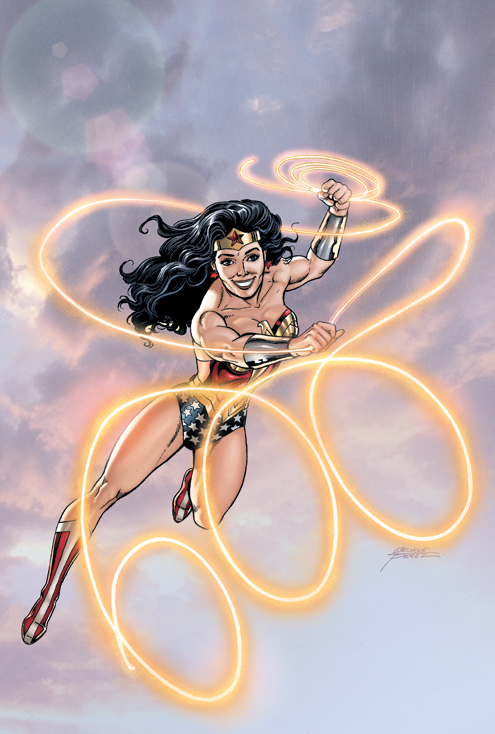
This week: Wonder Woman #600 features the beginning of J. Michael Straczynski’s run as a writer (and the end of Gail Simone’s). So how did Wonder Woman get to #600? 329 issues of the first series, 226 issues of the second series (that series also included issues numbered #0 and #1,000,000, but apparently those don’t count toward the total), and 45 issues of the series launched with a #1 cover-dated August, 2006.