



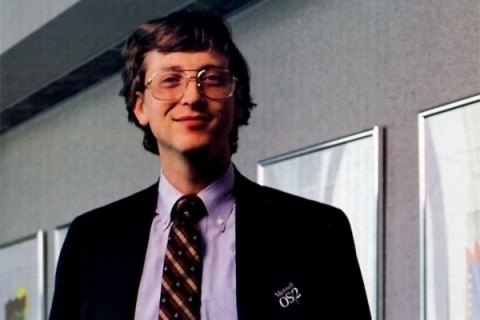
The July 1987 issue of PC World magazine featured a centerfold (!) of Microsoft CEO Bill Gates proudly sporting an OS/2 button
It was one of the most ambitious computer-product announcements in history. On April 2, 1987, at twin press conferences in New York and Miami, IBM unveiled its plans to reinvent the PC industry, which it had jump-started less than six years earlier with the introduction of the first IBM PC. The company introduced four new computers dubbed the PS/2 line, including an $11,000 model that it said was seven times faster than current models. The new products were rife with advanced features, including 32-bit processors, fancy graphics, 3.5-in. hard-shell floppy-disk drives and optical storage.
And the new hardware was accompanied by a next-generation operating system, OS/2. Co-developed by IBM and Microsoft, it was intended to replace DOS, the aging software that then powered most of the planet’s microcomputers.
(PHOTOS: A Brief History of the Computer)
It never did. Instead, Microsoft’s Windows reinvigorated DOS, helping end IBM’s control of the PC standard it had created. By the mid-1990s, IBM had given up on OS/2 — a major step in the company’s slow-motion retreat from the PC industry, which it completed in 2005 by agreeing to sell its PC division to China’s Lenovo.
But while OS/2 never truly caught on, it’s also never gone away. Even if you believe that you never saw it in action, there’s a decent chance that you unwittingly encounter it occasionally. More on that later.
Back in 1987, the possibility that the world might politely refuse to do as IBM instructed would have seemed implausible. Apple’s iconic “1984” TV commercial, which showed IBM customers as an army of unquestioning drones, was fantasy — but fantasy based on a certain degree of truth. Nobody, it was famously said, was ever fired for buying IBM. Yet OS/2 was an IBM product that the market, in general, chose not to buy.
When it was announced, however, the need seemed obvious, and its potential appeared to be huge. Tech writer Esther Schindler remembers:
I happened to be working at [leading software developer] Lotus as a contractor 25 years ago, on the day OS/2 1.0 was announced. A couple of guys had been locked in a room in the basement with several PS/2s and OS/2 1.0 … and emerged to show up the marvelous capabilities of the new hardware.
OS/2 promised multitasking, not just task switching. It knew how to handle memory … It did a heck of a lot of cool things … I don’t think it’s easy for young whippersnappers to grasp how big a deal the PS/2 and OS/2 were at the time. We were certain, absolutely certain, that nothing would be the same again. The closest I can come to it was the reaction after the first iPhone was released: the sense that It’s all different now.
As it turns out, the PS/2 and OS/2 1.0 didn’t have the impact everyone expected … but we thought they would.
OS/2 felt so important at first because DOS was still a gussied-up version of the rickety 16-bit software that Microsoft had licensed in 1980 for $10,000 from a tiny company called Seattle Computer Products. Windows, which first appeared in 1985, sat atop DOS and inherited its many flaws, such as the inability to utilize large amounts of memory and an eight-character limit on file names. The whole mess couldn’t utilize memory properly and was prone to frequent crashes. It was begging to be replaced.
Vaporous Beginnings
Of course, OS/2 couldn’t begin to replace anything until it shipped. And like many a technology product before and after, it remained vaporware for months after being announced. At the April 1987 launch, IBM said it intended to release the software in 1988, so when it finished the first version in December 1987, it got to say that OS/2 1.0 had shipped ahead of schedule.
GUIdebook
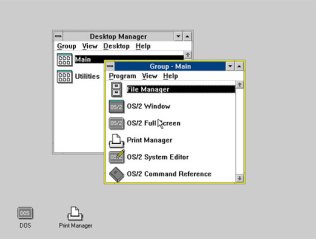
But OS/2 stayed vaporous and incomplete for years after that. The first version let you use DOS-style commands such as DIR and COPY but had no mouse-driven, graphical user interface; that didn’t show up until version 1.1 appeared in October 1988.
By November 1989, fewer than 200,000 copies of OS/2 had been sold, in part because it was far too resource-hungry to run on most existing computers. It needed a bare minimum of 4 megabytes of memory to run adequately in an era when it wasn’t a given that PCs had even 1 megabyte. PC World magazine later referred to the software’s “gargantuan size” and “lethargy.”
“[E]ven the recent 1.2 release is too buggy for general use,” carped PC World‘s Robert Lauriston in the February 1990 issue. “Consequently, it’s little used except by software developers, and large corporations with on-staff programmers.”
Meanwhile, Microsoft was two-timing the operating system it had co-created. In May 1990, it released Windows 3.0, the first version that was sort of decent. In terms of technical underpinnings, it remained creaky, but it gave garden-variety PCs the same sort of Mac-like pretty front end that OS/2 aspired to deliver. Consumers and businesses embraced Windows by the millions, instantly turning it from an apparent dud into a blockbuster. Every PC maker in the industry except IBM soon standardized on it.
With Windows suddenly flourishing, Microsoft decided it didn’t have to share the future of operating systems with anyone else. It not only began to sever ties with IBM but also argued that OS/2 was, in senior vice president of systems software Steve Ballmer’s cheery words, “a dead end.” The software that was originally supposed to be OS/2 3.0 morphed into Windows NT, the modernized version of Windows that both Windows XP and Windows 7 eventually descended from.
Wikipedia
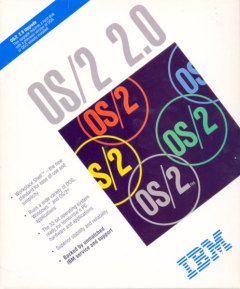
IBM soldiered on by itself, releasing OS/2 2.0 in April 1992, five years after the original OS/2 announcement. It was the first version that seemed less like an experiment and more like a fully realized commercial product.
Unlike Microsoft’s Windows 3.1, OS/2 2.0 was a (mostly) 32-bit piece of software, capable of harnessing the full computing power of PCs that used 386 and 486 processors. It could effortlessly and safely multitask OS/2 programs, Windows programs and DOS programs; IBM marketed it heavily as “a better Windows than Windows,” a claim that had some merit. More than 250 companies declared their intention to deliver OS/2 apps, including biggies such as Lotus, WordPerfect, Borland and Novell.
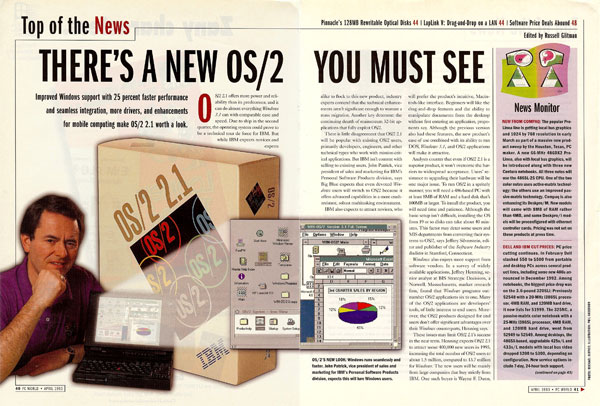
“Back from the dead?” wrote PC World‘s Anita Amirrezvani in the July 1992 issue. “Not quite, but OS/2 has made an unexpected comeback.” She said that business types were giving version 2.0 consideration. But she also pointed out Windows’ advantages and noted that OS/2 needed a fast 386 computer with 6 MB of memory and 15 MB to 30 MB of hard-disk space — daunting hardware requirements at the time.
PCWorld
The new version helped OS/2’s prospects, at least somewhat: in October, IBM said it had shipped 1.7 million copies, more than all the previous OS/2 versions put together.
In May 1993, IBM released OS/2 2.1; like 2.0 before it, it was greeted as the version of OS/2 that might end the operating system’s underdog status. IBM’s John Patrick told PC World that even Windows devotees would switch to OS/2, since it multitasked better and crashed less.
A 1993 episode of public TV series The Computer Chronicles had a skeptical-sounding title — “Whatever Happened to OS/2?” — but provided a largely upbeat update on 2.1’s prospects:
[youtube=http://www.youtube.com/watch?v=nLGwpH86zNw]
Still, any evidence that OS/2 was succeeding tended to look puny in the shadow of the overwhelming success of Windows. Most of the software companies that had pledged their support to IBM redeployed their energies to the vastly larger Windows market. In a move that was both symbolic and practical, a magazine that had started out with the name OS/2 changed its name to OS/2 and Windows. And then to Windows and OS/2. And then, inevitably, to Windows.
Getting Warped
OS/2 3.0, released in November 1994, was dubbed OS/2 Warp — part of a concerted effort on IBM’s part to make the operating system seem less nerdy and more hip and consumer-friendly.
It even advertised the product on TV. Here’s a commercial that tries to explain OS/2 to non-nerds (it seems like the spot gives up halfway through). At the end, it simply says OS/2 is “a totally cool way to run your computer,” which is both vague and patronizing.
[youtube=http://www.youtube.com/watch?v=PY8WbTe1G0Q]
Warp included features, like the ability to tweak any object’s settings by right-clicking it, that would show up in Windows years later. Microsoft’s big Windows upgrade — code-named “Chicago” and eventually released as Windows 95 — was still vaporware, and IBM and OS/2 fans hoped that its continued absence might lead Windows to look elsewhere. One OS/2 aficionado, Charles Forsythe, composed a widely circulated satirical press release that had Microsoft offering to put Windows users into cryogenic suspension until Windows 95 was released. (He happens to be a high school buddy with whom I spent countless hours futzing around with computers, before either Windows or OS/2 existed.)
“Like anything that was in some ways ahead of its time,” Forsythe remembers, OS/2 “missed some features that seem obvious now. Probably its biggest weakness was one no one really noticed at the time: it was a single-user operating system at a time when networking was about to make it really important to know who or what is doing this? Today even consumer OSes such as OS X and Windows 7 make a clear distinction between regular and administrative users — even in cases where a PC only has one actual person who uses it.”