


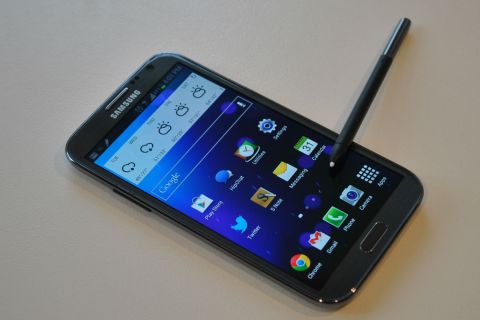
How big can Samsung’s Galaxy Note go? Apparently not as huge as we originally expected.
Last December, Korea Times reported that the Galaxy Note III would have a 6.3-inch display, citing “officials from local parts suppliers.” Now, the same publication is changing its tune, quoting an anonymous “official” who says the Note III will have a 5.9-inch display instead.
Either screen size would be larger than the Galaxy Note II (pictured), whose display measures 5.5-inches diagonally — but that’s to be expected. Samsung is announcing its flagship Galaxy S4 smartphone next week, and all signs point to a 4.99-inch display, which would be about 0.2 inches larger than its predecessor. If the S4 is getting bigger, the Note III is likely to follow, maintaining a decent size gap between the two devices.
Still, I winced after reading that the screen might grow to 6.3 inches. At that size, the perennial phone-tablet crossover would veer into tablet territory, and could be tough to stuff into a pants pocket. (That was certainly the case with Huawei’s Ascend Mate, a 6.1-inch “phablet” that I briefly tried at CES in January.) The Note II is big, but it’s not so big that you can’t treat it like a smartphone. And I really liked the Note II.
Hopefully Korea Times’ latest report is the correct one, and even if the Note III has a larger screen than its predecessor, perhaps Samsung can minimize the physical footprint by using smaller bezels around the sides and top of the device. We’ll find out more in the second half of the year when Samsung is expected to announce the Note III.